
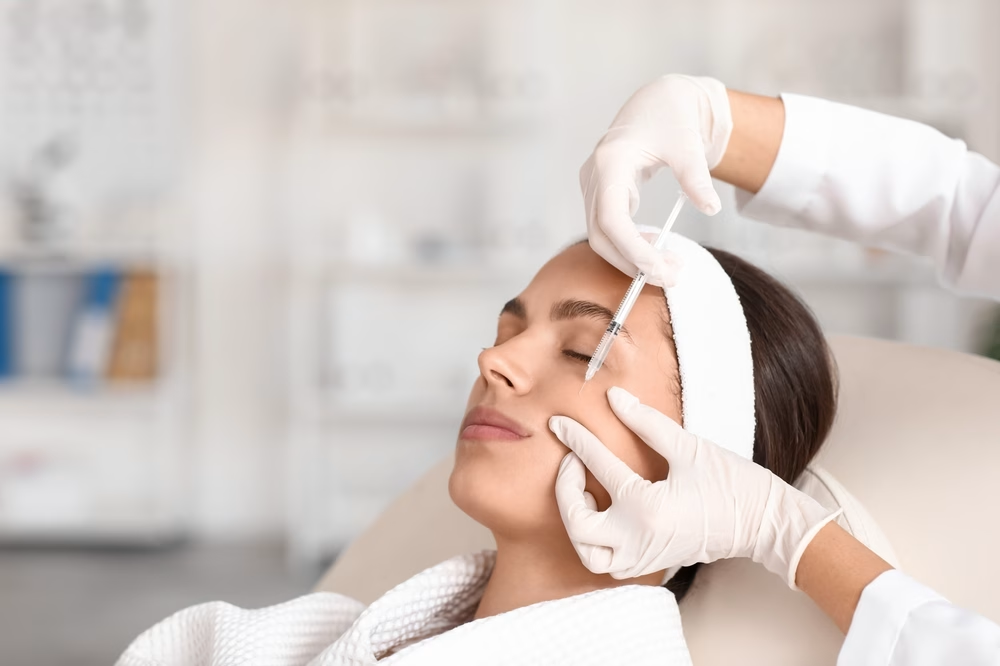

If you have been searching for a way to fix under-eye hollows, you have likely come across various treatments promising to make you look as rested as you feel. You might see shadows, circles, or a flat transition where your cheek meets your lower lid and wonder if Sculptra near Long Island is the right fix. However, advice on this topic is often split; some claim it is a miracle for volume, while others warn it should never go near the eyes.
This is where things get tricky. The real answer to whether Sculptra belongs under the eyes is that it depends. It depends on your skin, the way your eyes age, and the skill of the person holding the needle. At Lysty Aesthetics & Wellness, we believe you deserve a clear breakdown of the pros, cons, and science behind what clinicians are seeing in real patients.
What Sculptra Actually Is (And Why That Matters Under the Eyes)
To decide if Sculptra belongs anywhere near your tear troughs, you first need to know what it is. Sculptra is not a classic gel filler like the lip fillers you might be familiar with. It is made from poly-L-lactic acid (PLLA), a material that pushes your body to grow more collagen over time.
Instead of sitting there as a gel like many hyaluronic acid fillers do, these tiny PLLA particles act more like a signal. They nudge nearby cells to build new structural fibers so the skin thickens and gains support over several months. A good overview of PLLA and its role as a collagen stimulator is laid out in a review on poly-L-lactic acid use in aesthetics from the National Library of Medicine.
At clinics like Lysty Aesthetics & Wellness, practitioners use Sculptra to create a scaffold that helps the body produce its own tissue volume. It is often an excellent choice for larger areas like the temples or cheeks where there is substantial fat loss. However, the under-eye area is a delicate zone with very thin skin.
Because it is injected to stimulate the body’s natural collagen, the results appear slowly. That slow collagen response is a double-edged sword:
- The Pro: It offers natural-looking rejuvenation that does not look “overdone” or puffy.
- The Con: Predicting exactly how much volume will develop in the tear trough can be challenging.
While a dermal filler made of hyaluronic acid gives immediate feedback, PLLA requires patience. You might not see the full benefit for three to four months. This makes it distinct from other procedures like a chemical peel or laser skin resurfacing which work primarily on the surface.
So, Can Sculptra Be Used Under the Eyes at All?
Short answer: yes, it can. Long answer: it should only be used under very specific conditions and only by someone who is deeply experienced with it. It is considered an off-label use, meaning the FDA approved it for other areas, but providers use it here based on professional judgment.
Several facial plastic surgeons and dermatologists use Sculptra to soften the transition between the lower eyelid and the midface. They generally avoid shooting it right into the delicate tear trough line near the lash line. Instead, they target the structural support below it to “blur” the hollow.
Clinical Insight: A recent paper in the Journal of Drugs in Dermatology describes PLLA as a safe way to blur that lower eyelid-to-cheek “step off” when handled carefully and in the right layer of tissue.
There is also a study on nonsurgical lower eyelid rejuvenation in Asian patients that reported improvement in hollowing and shadows without major complications. This gives us evidence that the approach can work when technique and dosing are conservative. This is a philosophy echoed by the team at Lysty Aesthetics & Wellness, who prioritize natural, subtle enhancements over aggressive filling.
Why Under Eye Skin Is So Easy To Mess Up
The reason people are split on this topic is simple: the under-eye area is one of the hardest parts of the face to treat. It is far more unforgiving than areas treated for double chin reduction or cheek augmentation.
The skin there is thin, mobile, and rests on a network of blood vessels and ligaments. Small changes in volume can look very obvious. This is why many injectors default to hyaluronic acid fillers for under-eye hollows; they can be reversed with an enzyme called hyaluronidase if the result is off. Sculptra cannot be dissolved.
However, Lysty Aesthetics & Wellness and other specialized practices sometimes prefer biostimulators like Sculptra because they do more than just fill; they increase dermal thickness and help the skin act “younger” by addressing the root cause of the hollow: collagen loss.
How Sculptra Behaves Under The Eyes vs. Fillers
Understanding the mechanics is key to knowing if you are a good candidate.
| Feature | Sculptra (PLLA) | Hyaluronic Acid Filler |
| Main Role | Triggers natural collagen production | Provides instant volume from gel |
| Onset | Weeks to months | Immediate |
| Reversible? | No | Yes (with hyaluronidase) |
| Best For | Deep hollowing & thinning skin | Precise tear trough corrections |
| Duration | Up to 2 years | 6 to 18 months |
If your main concern is strictly dark circles caused by pigment, neither might be the best first step. In those cases, Lysty Aesthetics & Wellness might recommend chemical peels or laser skin treatments. Sculptra primarily addresses the physical hollows that cast shadows.
Who Is A Good Candidate?
According to treatment protocols used at Lysty Aesthetics & Wellness, you might be a candidate if:
- You have real volume loss rather than just “puffiness.”
- Your lower lid skin is not paper-thin or crepey at rest.
- You have decent skin elasticity.
- You are patient and looking for a long-term, natural change.
Who should avoid it? Those with pronounced eye bags, extremely thin skin, or a history of fluid retention (edema) under the eyes. In these cases, adding a biostimulator can sometimes worsen the “puffy” look.
The Treatment Experience at Lysty Aesthetics & Wellness
If you and your injector decide Sculptra is the right path, the session usually involves:
- Mapping: A careful map of your midface and eyelid junction.
- Cannula Technique: Many providers prefer using a blunt-tipped cannula to reduce bruising and help the product sit in the correct deep plane.
- Dilution: The Sculptra is mixed with sterile water and lidocaine to make the product more spread out.
- Aftercare: You will likely be given specific instructions on how to massage the area to make the particles settle evenly and prevent the formation of nodules.
Conclusion
So, can Sculptra be used under the eyes? Yes, it can, and it has been used successfully in clinical research and real-world practices. In the right hands, such as the experienced injectors at Lysty Aesthetics & Wellness, it can gradually build collagen, soften harsh hollows, and make the skin look thicker over time.
If you are still curious, the smartest next step is a face-to-face consultation. The point is not to chase one trendy product, but to pick the method that lets your eyes match how awake and alive you actually feel. Contact us with your questions and your goals.